Rwanda’s business landscape is undergoing rapid digital transformation. As companies scale operations across accounting, inventory, human resources, and customer management, the need for integrated enterprise resource planning (ERP) software has become critical. Yet many Rwandan SMEs and growing businesses face a difficult choice: invest in expensive, complex ERP systems like SAP Business One, or settle for fragmented, disconnected software solutions that create operational silos.
Odoo ERP offers a compelling third path—a modern, affordable, and locally compliant solution that addresses the unique needs of Rwanda’s business environment. Unlike legacy ERP systems designed for large enterprises, Odoo was built from the ground up to serve growing businesses. With native integration for Rwanda Revenue Authority (RRA) compliance, Electronic Billing Machine (EBM) connectivity, and Rwanda Social Security Board (RSSB) payroll regulations, Odoo eliminates the friction of manual tax filing and compliance management.
This comprehensive guide explores why Odoo has emerged as the best ERP system for Rwanda’s SMEs and mid-market companies in 2026, backed by market data, real-world implementation examples, and direct comparisons with competing solutions.
The Rwanda ERP Market in 2026: Why Now? Market Growth and Digital Transformation Momentum
Rwanda’s digital transformation is accelerating rapidly. The Africa Digital Transformation Market reached USD 34.97 billion in 2026 and is projected to grow at a compound annual growth rate (CAGR) of 15.62% through 2031, reaching USD 72.23 billion . Within this broader trend, cloud-based enterprise software adoption is surging across East Africa, driven by improved internet infrastructure, declining cloud service costs, and increasing pressure on businesses to digitize operations .
Rwanda’s economy itself is robust, with real GDP growth expected to expand by approximately 7.5% in 2026 . This economic expansion is fueling demand for business management tools that can help companies scale efficiently without proportional increases in overhead costs.
The ERP Market Opportunity
The global ERP software market was valued at USD 97.77 billion in 2024 and is projected to reach USD 199.59 billion by 2030, representing an 11.6% CAGR . Within the Middle East and Africa (MEA) region, cloud ERP systems are growing at approximately 14% annually, outpacing global averages . This growth reflects a fundamental shift: businesses are moving away from on-premise, capital-intensive ERP deployments toward cloud-based, subscription-driven models that offer flexibility and lower upfront costs.
For Rwanda specifically, this trend presents an opportunity. SMEs and growing businesses can now access enterprise-grade software without the massive capital expenditure and IT infrastructure requirements that made ERP adoption prohibitive just five years ago.
Understanding ERP: Why Your Business Needs One. What is an ERP System?
An ERP (Enterprise Resource Planning) system is integrated business management software that connects all core business functions—accounting, inventory management, human resources, customer relationship management (CRM), sales, procurement, and reporting—into a single, unified platform. Rather than maintaining separate, disconnected systems for each function, an ERP consolidates data into a centralized database, enabling real-time visibility and automated workflows across the entire organization .
The Business Case for ERP in Rwanda
For Rwandan businesses, the benefits of ERP adoption are substantial:
Operational Efficiency: ERP systems automate routine tasks like invoice processing, payroll calculations, and inventory updates. This automation reduces manual data entry errors, frees up staff to focus on strategic work, and accelerates business processes. Studies show that companies implementing ERP systems experience productivity gains of 20-40% within the first year .
Real-Time Decision Making: With all business data flowing into a centralized system, managers and executives gain instant access to dashboards, reports, and analytics. This real-time visibility enables faster, more informed decision-making. For example, a retailer can see inventory levels across all locations instantly, preventing stockouts and overstock situations.
Regulatory Compliance: Rwanda has specific tax and payroll compliance requirements. The RRA mandates electronic invoicing through EBM, RSSB requires precise payroll deductions and reporting, and VAT filing has strict deadlines. An ERP system that understands these local requirements can automate compliance, reducing the risk of penalties and audit issues.
Cost Control: By automating workflows and providing visibility into spending, ERP systems help businesses identify cost-saving opportunities. Companies typically achieve 15-25% reductions in operational costs within 18-24 months of ERP implementation .
Scalability: As your business grows, an ERP system grows with you. You can add users, modules, and functionality without replacing the entire system. This scalability makes ERP a long-term investment rather than a short-term fix.
The Odoo Advantage: Why Odoo Leads Rwanda’s ERP Market
What Makes Odoo Different
Odoo is an open-source, modular ERP platform that has gained significant traction globally and is now becoming the preferred choice for Rwanda’s growing businesses. As of 2026, Odoo serves over 6 million users across 190 countries and has become the fastest-growing ERP solution among SMEs . But what makes Odoo particularly suited to Rwanda?
1. Affordability and Transparent Pricing
The most significant barrier to ERP adoption for Rwandan SMEs has historically been cost. SAP Business One, the market leader in Rwanda, typically requires substantial upfront licensing fees, implementation costs, and ongoing support expenses. For a small business with 20-50 employees, SAP implementation can cost USD 50,000-150,000 or more .
Odoo operates on a fundamentally different pricing model. Rather than expensive perpetual licenses, Odoo uses a subscription-based approach where you pay only for the modules you use. A small business might start with just accounting and inventory modules for USD 20-30 per user per month, then add CRM, HR, or e-commerce modules as the business grows . This modular approach means you’re not paying for features you don’t need, and you can scale spending as revenue grows.
Real-World Impact: A Kigali-based manufacturing company with 35 employees switched from SAP Business One to Odoo and reduced their annual software costs by 60% while gaining additional functionality and faster implementation .
2. Native Rwanda Compliance and Local Integration
This is where Odoo truly differentiates itself for Rwanda. Unlike generic ERP systems, Odoo has been customized by local partners to integrate seamlessly with Rwanda’s regulatory environment.
EBM (Electronic Billing Machine) Integration: Rwanda Revenue Authority requires all businesses above a certain turnover threshold to use Electronic Billing Machines (EBM) for invoicing. Odoo integrates directly with EBM 2.1, the current RRA standard, automating invoice generation and transmission to the RRA’s system . This eliminates the manual process of creating invoices in Odoo, then re-entering them into a separate EBM system—a common pain point for businesses using non-integrated software.
RSSB Payroll Compliance: Rwanda Social Security Board (RSSB) contributions are mandatory for employers and include PAYE (income tax), pension contributions, medical insurance, and occupational hazard insurance. Odoo’s payroll module has been customized by local partners (such as ADFinance) to automatically calculate RSSB deductions according to current Rwandan regulations, ensuring compliance and reducing payroll processing time .
RRA Tax Compliance: Odoo tracks VAT, PAYE, and other tax obligations in real-time, with built-in alerts for filing deadlines. The system can generate tax reports required by RRA, reducing the time your finance team spends on compliance and minimizing the risk of missed deadlines or incorrect filings.
Local Support Ecosystem: Companies like Sokrab, ADFinance, and Advance Insight provide Odoo implementation and customization services specifically tailored to Rwanda’s business environment. This means you’re not working with a generic implementation partner; you’re working with experts who understand local compliance, business practices, and market dynamics.
3. Modular Architecture for Flexible Growth
Odoo’s modular design is a game-changer for growing businesses. Unlike traditional ERP systems that force you to implement all modules at once, Odoo allows you to start with core modules (accounting, inventory) and add others as needed (CRM, HR, e-commerce, manufacturing, etc.). This approach offers several advantages:
•Lower Implementation Risk: Implementing fewer modules means faster deployment, lower costs, and easier change management
•Phased Investment: You can spread ERP implementation costs over time, aligning software investments with business growth
•Module Flexibility: If you need to add a new business function, you can activate a new module without disrupting existing operations
•Integration: All modules share the same database and user interface, ensuring seamless data flow between functions
For example, a Rwandan trading company might start with Odoo’s accounting and inventory modules, then add the CRM module six months later when they want to improve customer management, followed by the e-commerce module when they’re ready to launch online sales.
4. User-Friendly Interface and Rapid Adoption
One of the most common reasons ERP implementations fail is poor user adoption. Complex, unintuitive systems frustrate employees, leading to workarounds, data quality issues, and ultimately, failed implementations.
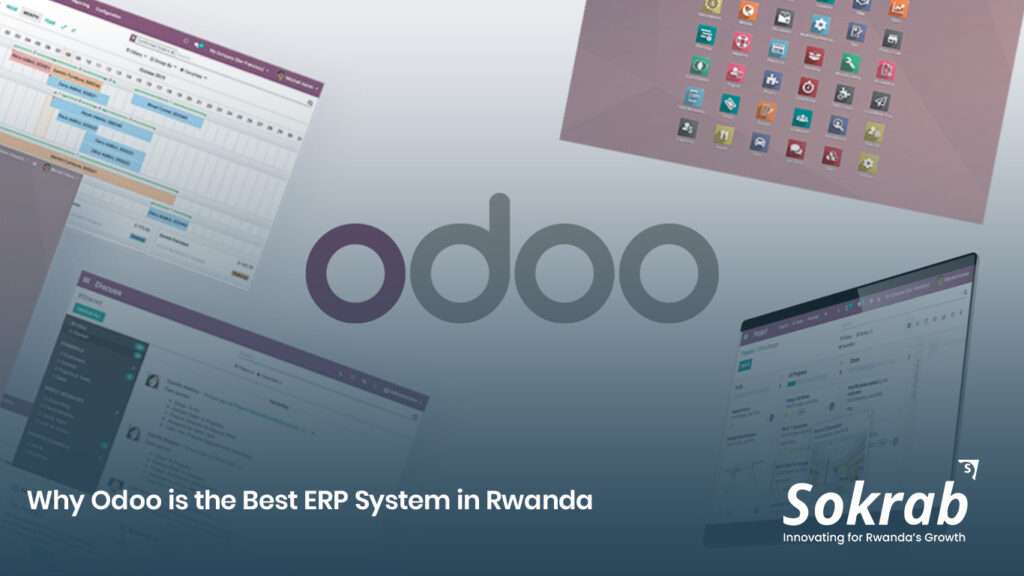
Odoo was designed with user experience as a core principle. The interface is modern, intuitive, and role-based—meaning each user sees only the information and functions relevant to their role. A warehouse manager sees inventory and picking lists; an accountant sees invoices and general ledger entries; a sales manager sees customer pipelines and revenue forecasts .
This user-centric design significantly reduces training time and accelerates adoption. Most Odoo users become productive within 2-3 weeks of training, compared to 8-12 weeks for more complex ERP systems .
5. Cloud-Based Flexibility and Accessibility
Odoo is available as a cloud-based SaaS solution, meaning you access it through a web browser from anywhere with an internet connection. This flexibility is particularly valuable for Rwandan businesses that may have distributed teams or remote workers.
Cloud deployment also eliminates the need for expensive on-premise IT infrastructure, reduces the burden on internal IT teams, and ensures automatic software updates and security patches. The vendor handles all maintenance, backups, and security, allowing your team to focus on business operations rather than IT administration .
6. Open-Source Flexibility and Customization
While Odoo offers a commercial cloud version, it’s also available as open-source software. This means if you have specific business requirements that aren’t met by standard Odoo functionality, you can customize or extend the system. Local implementation partners have the expertise to build custom modules, integrations, and workflows tailored to your unique business needs.
This flexibility is particularly valuable for businesses in specialized industries (manufacturing, agriculture, logistics) where standard ERP features may not fully address industry-specific requirements.
Addressing Common Concerns About Odoo
“Will Odoo work for my industry?”
Odoo has pre-built solutions for numerous industries including manufacturing, trading, retail, agriculture, logistics, and professional services. If your industry requires specialized functionality, Odoo’s open-source nature and local partner expertise make customization feasible.
“What about data security and compliance?”
Odoo cloud deployments include enterprise-grade security including SSL encryption, regular backups, disaster recovery, and compliance with international data protection standards. For Rwanda-specific compliance (EBM, RSSB, RRA), local implementation partners ensure configurations meet regulatory requirements.
Why Sokrab is Your Ideal Odoo Implementation Partner in Rwanda
Sokrab is a leading IT services and business advisory firm based in Kigali, Rwanda, with deep expertise in Odoo implementation and customization. Here’s why Sokrab stands out as your ideal partner:
Local Expertise: Sokrab’s team understands Rwanda’s business environment, regulatory requirements, and market dynamics. They’ve successfully implemented Odoo for dozens of businesses across various industries.
Rwanda Compliance Specialization: Sokrab specializes in configuring Odoo for Rwanda-specific compliance including EBM integration, RSSB payroll compliance, and RRA tax requirements.
End-to-End Services: Beyond Odoo implementation, Sokrab offers business advisory, IT consultancy, and ongoing support services, providing a comprehensive partnership.
Local Support: With offices in Kigali, Sokrab provides on-site support during implementation and ongoing assistance after go-live.
Proven Track Record: Sokrab has implemented Odoo for trading companies, manufacturers, service providers, and NGOs across Rwanda.
Getting Started with Odoo: Next Steps
If you’re considering Odoo for your business, here are the recommended next steps:
- Schedule a Consultation: Contact Sokrab for a free consultation to discuss your business requirements, current challenges, and how Odoo can address them.
- Conduct a Needs Assessment: Work with Sokrab to assess your business processes, identify pain points, and define ERP requirements.
- Explore a Demo: Request a demo of Odoo configured for Rwanda compliance to see how the system works.
- Develop an Implementation Plan: If you decide to proceed, Sokrab will develop a detailed implementation plan including timeline, costs, and resource requirements.
- Begin Implementation: With a clear plan in place, your Odoo implementation journey begins.
Conclusion: Why Odoo is Rwanda’s Best ERP Choice in 2026
Rwanda’s business landscape is evolving rapidly. As companies scale operations and regulatory requirements become more complex, the need for integrated, compliant, and affordable ERP software is no longer optional—it’s essential for competitive survival.
Odoo represents a paradigm shift in ERP accessibility. By combining affordability, local compliance, user-friendly design, and a strong local partner ecosystem, Odoo has become the best ERP system for Rwanda’s SMEs and growing businesses.
Whether you’re a trading company managing multiple locations, a manufacturer optimizing production, a service provider tracking projects, or an NGO managing operations, Odoo provides the integrated platform you need to streamline operations, improve decision-making, and drive profitable growth.
The question is no longer whether your business needs an ERP system—it’s which ERP system will best serve your needs. For most Rwandan businesses in 2026, the answer is Odoo.
Ready to transform your business with Odoo? Contact Sokrab today for a free consultation and discover how Odoo can streamline your operations, improve compliance, and drive growth.